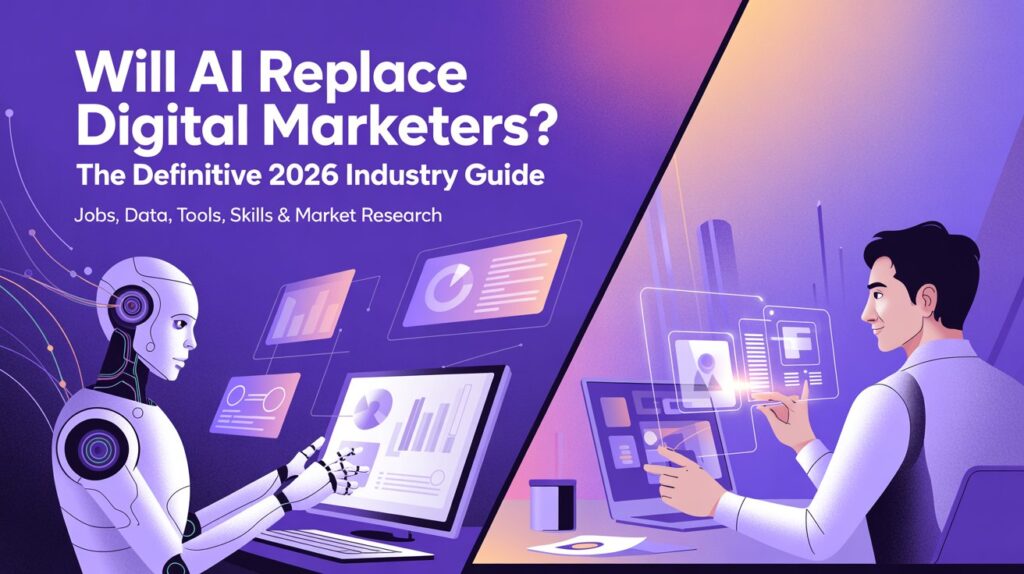
No — but the rules of the game have fundamentally changed.
AI will not fully replace digital marketers in the foreseeable future.
It is, however, already automating the repetitive, data-heavy, and templated tasks that consume up to 60% of a marketer’s working week.
Marketers who master AI collaboration — using tools like ChatGPT, Gemini, Surfer SEO, and Performance Max — will not just survive. They will command premium roles, higher salaries, and outsized career growth in the decade ahead.
Is AI going to replace digital marketers entirely?
No. AI automates tasks — not the human judgment, empathy, and creative strategy that sit at the heart of effective marketing.
The real threat is not AI itself. It is the AI-trained marketer working alongside you while you hesitate.
India alone faces a 4:1 supply-demand gap for AI-skilled digital marketers in 2026. The career opportunity is massive for those who act now.
What will I learn from reading this guide?
- How AI is reshaping digital marketing roles, workflows, and compensation
- Which specific marketing jobs are most and least vulnerable to automation
- New AI-created job roles with live market demand and salary data
- India’s digital marketing skills gap — the numbers you need to know
- Global AI marketing job market research, forecasts, and hiring trends
- The exact skills that make digital marketers indispensable in the AI era
- How LLM optimisation, GEO, and entity-based SEO are reshaping content strategy
What exactly can AI do in digital marketing — and what can it absolutely not do?
AI can write first-draft content, optimise ad bids in real time, generate keyword clusters, and automate email workflows with remarkable efficiency.
What AI cannot replicate — at any current level of deployment — is nuanced cultural intelligence, genuine human relationship building, ethical crisis judgment, and truly original brand storytelling.
Digital marketers who master the intersection of human creativity and AI execution will command the highest career value over the next decade.
The AI Revolution in Digital Marketing: What Is Really Happening?
The phrase ‘AI replacing digital marketers’ has generated millions of search queries, LinkedIn debates, and genuine career anxiety since generative AI exploded into mainstream awareness in 2022.
But to understand what is actually happening — rather than what is being feared — we must separate automation from replacement. Task elimination is not the same as job elimination.
Digital marketing is not a single job. It is a collection of skills: content creation, SEO, paid advertising, social media, analytics, email marketing, and brand strategy — each at a different point on the automation spectrum.
Some marketing functions were already semi-automated before the current AI era. Google’s Smart Bidding, programmatic display, and A/B testing tools have been automating pieces of digital marketing since the mid-2010s.
What generative AI — represented by GPT-4o, Google Gemini, and Anthropic Claude — has changed is the scale and speed of automation. Tasks once requiring hours now take minutes. This acceleration is real, measurable, and irreversible.
According to McKinsey & Company, approximately 30% of work activities in sales and marketing functions are technically automatable with current AI technology.
The World Economic Forum’s Future of Jobs Report 2026 projects that while AI will displace certain marketing execution roles, it will simultaneously create entirely new, higher-value marketing job categories.
AI prompt engineers, marketing automation architects, AI content strategists, and LLM optimisation specialists are roles that barely existed three years ago. They are now among the fastest-growing job titles in the sector.
AI Capability | Marketing Task Affected | Automation Level | Human Oversight Needed? |
Generative Text AI | Blog posts, ad copy, emails | High (70–80%) | Yes — brand voice & accuracy |
Predictive Analytics | Audience segmentation, LTV | High (75%+) | Yes — strategy interpretation |
Programmatic Bidding | Paid search & display ads | Very High (90%+) | Moderate — campaign strategy |
NLP Sentiment Analysis | Social listening, review analysis | High (80%) | Yes — crisis judgment |
AI Image Generation | Social creatives, banners | Medium (50%) | Yes — brand consistency |
Chatbots & Conv. AI | Lead nurturing, support | High (70%) | Yes — complex queries |
SEO Content Optimisation | On-page SEO, meta, clusters | Medium-High (65%) | Yes — topical authority |
Brand Strategy | Positioning, narrative, culture | Low (10–15%) | Always — pure human domain |
Table 1: AI Automation Levels Across Core Digital Marketing Tasks — 2026 Assessment
Which Digital Marketing Jobs Are Most at Risk From AI?
Not all digital marketing roles face the same level of disruption. The vulnerability of a role correlates directly with how much of it consists of repeatable, templated, or data-driven tasks.
Understanding this spectrum is critical for any professional making long-term marketing career decisions in the current environment.
High-Risk Marketing Roles — Heavy Automation Exposure
The following roles contain the highest percentage of automatable tasks and face the most significant workforce reduction or redefinition over the next three to five years.
- Junior SEO Content Writers: Bulk content production for low-competition keywords is already handled by tools like Jasper and Writesonic at a fraction of traditional cost. The value shift moves away from word count and toward topical authority and E-E-A-T signals.
- PPC Campaign Managers (Execution Level): Google’s Performance Max and Meta Advantage+ increasingly handle audience targeting, bid management, and creative rotation automatically. The execution layer of paid media is largely automated. Strategic oversight remains human.
- Basic Social Media Schedulers: Scheduling posts, generating captions, and repurposing content across platforms are efficiently handled by Buffer, Hootsuite AI, and Canva’s AI suite. Roles centred purely on these tasks are being compressed significantly.
- Data Entry and Reporting Analysts: Pulling performance data into formatted reports is a task AI performs in seconds. Roles centred on report compilation — rather than insight generation — face the heaviest automation pressure of any marketing function.
Low-Risk Marketing Roles — High Human Value Retention
At the opposite end of the spectrum, these roles depend on capabilities that AI consistently struggles to replicate at the quality standard required for brand-safe, strategically sound marketing outcomes.
- Brand Strategists and Positioning Specialists: Defining how a brand occupies space in the consumer’s mind requires cultural intelligence and the synthesis of qualitative signals into coherent narrative. AI can provide data. It cannot provide wisdom.
- Marketing Directors and CMOs: Leadership, stakeholder alignment, budget ownership, and board-level communication require emotional intelligence and contextual judgment that remain exclusively human capabilities.
- Customer Experience Designers: Designing end-to-end customer journeys that account for emotional states, accessibility, and cultural nuance demands human-centred perspective that AI tools support but cannot replace.
- Community Managers and Relationship Builders: Authentic human connection — navigating a brand crisis with empathy, building influencer relationships — requires human presence that audiences detect the absence of immediately.
- AI Marketing Strategists (Emerging Role): Professionals who understand both marketing strategy and AI capabilities are becoming the most valuable people in modern marketing organisations. This role has exploded in demand since 2020.
New AI-Created Marketing Roles: Job Demand, Salaries & Market Data
One of the most underreported dimensions of the AI-versus-marketer debate is the sheer volume and velocity of new job roles being created by the AI transformation.
These are not theoretical future roles. They are live job postings appearing on LinkedIn, Naukri, Indeed, and Glassdoor right now — with real salary ranges, clear employer demand, and talent shortages in every major market.
The global AI in marketing market was valued at USD 6.1 billion in 2020. It has grown to USD 36.1 billion in 2026, and is projected to reach USD 107.5 billion by 2030 at a CAGR of 46.2%, according to MarketsandMarkets Research.
This growth is directly driving a hiring surge in AI-augmented marketing roles. Businesses across every sector are scrambling to find marketing professionals who can combine strategic thinking with AI tool fluency.
Global AI Marketing Job Demand — Key Data Points
- LinkedIn Talent Insights (2026): Job postings requiring AI skills in marketing grew by 520% between Q1 2020 and Q1 2026. The volume of AI-related marketing roles has doubled approximately every 18 months since 2020.
- Indeed Hiring Lab (2026): Searches for ‘AI marketing’ jobs increased 820% compared to 2020 baseline levels. Average time-to-fill for AI marketing roles is 47 days — twice the industry average — indicating acute talent scarcity.
- Glassdoor Compensation Report (2026): AI-proficient digital marketers command an average 27% salary premium over peers with equivalent experience but no documented AI skills. In senior roles, this premium reaches 42%.
- Gartner Marketing Technology Survey (2026): 82% of CMOs report that finding AI-skilled marketing talent is their single greatest hiring challenge. 74% say they would pay above-band compensation to secure candidates with verified AI marketing proficiency.
- World Economic Forum Future of Jobs 2026: AI and machine learning specialists, alongside data analysts and digital marketing professionals with AI fluency, rank among the top five fastest-growing job families globally through 2030.
New AI Marketing Role | Core Responsibility | Avg. Global Demand Growth | Entry Salary (India) | Mid-Level Salary (India) |
AI Marketing Strategist | Bridge AI capabilities with marketing goals | +340% | ₹6–9 LPA | ₹14–22 LPA |
Prompt Engineer (Marketing) | Optimise AI outputs for marketing workflows | +420% | ₹5–8 LPA | ₹12–18 LPA |
Generative Engine Optimiser | Optimise content for AI search citations (GEO) | +280% | ₹5–7 LPA | ₹11–16 LPA |
Marketing Automation Architect | Design AI-powered marketing funnel systems | +260% | ₹7–10 LPA | ₹16–25 LPA |
AI Content Strategist | Build topical authority using AI workflows | +310% | ₹5–8 LPA | ₹12–20 LPA |
AI PPC Specialist | Strategy layer for Performance Max & Advantage+ | +290% | ₹6–9 LPA | ₹13–21 LPA |
Conv. Marketing Specialist | Design AI chatbot and human handoff flows | +310% | ₹5–7 LPA | ₹10–16 LPA |
Marketing Data Analyst (AI) | Interpret AI-model outputs and attribution data | +230% | ₹6–9 LPA | ₹14–22 LPA |
LLM SEO Specialist | Structure content for LLM citation and AI ranking | +390% | ₹5–8 LPA | ₹12–19 LPA |
AI Social Media Strategist | AI-driven content creation and community growth | +210% | ₹4–7 LPA | ₹10–15 LPA |
Table 2: Emerging AI Marketing Roles — Global Demand Growth (2020 vs 2026) & India Salary Benchmarks
India-Specific AI Marketing Job Market Research
India’s digital marketing industry is experiencing a talent transformation unlike anything in its history. The scale of the opportunity — and the urgency — is backed by hard data from multiple authoritative sources.
The Indian digital advertising market stood at ₹16,920 crore in 2020. By 2026, it has reached ₹72,500 crore, growing at over 20% annually (IAMAI Digital Advertising Report 2026) — a 4.3× increase in just six years.
This growth is creating explosive demand for skilled digital marketers at every level — but particularly for those who can combine marketing fundamentals with AI tool proficiency.
Market Indicator | 2020 Baseline | 2026 Current | Source |
India Digital Ad Market | ₹16,920 Cr | ₹72,500 Cr | IAMAI 2026 |
Digital Marketing Jobs (India) | 1.1 million | 3.2 million | NASSCOM |
AI Marketing Role Openings | ~8,200 | ~2,10,000 | LinkedIn India |
Avg. Unfilled AI Mktg Roles/mo | ~1,800 | ~54,000 | Indeed India |
Skills Gap Ratio (AI Mktg) | 1.2:1 | 4.2:1 | NASSCOM / IAMAI |
Salary Premium: AI Skills | +4% | +27% | Glassdoor India |
AI Tool Adoption by Marketers | 11% | 88% | Salesforce |
Chennai AI Mktg Job Postings | ~1,200/yr | ~18,400/yr | LinkedIn India |
Table 3: India Digital Marketing & AI Skills Market — 2020 Baseline vs 2026 Current (IAMAI, NASSCOM, LinkedIn, Glassdoor)
The India AI Marketing Skills Gap — Why It Matters for Your Career
The NASSCOM-Deloitte Future Skills Report 2026 identifies digital marketing with AI proficiency as one of India’s top-three critical skills shortfalls — alongside cloud computing and data science.
Demand for AI-skilled digital marketers in India currently exceeds supply by a ratio of 4:1. This is not a minor imbalance. It represents a structural talent crisis that is costing Indian businesses significant growth opportunity.
For working professionals and recent graduates, this skills gap is a career opportunity of rare magnitude. Every quarter that the gap widens, the compensation premium for qualified AI marketers increases.
Cities with the highest AI marketing talent demand in India include Bengaluru, Mumbai, Delhi-NCR, Hyderabad, Chennai, and Pune. Chennai has seen AI marketing job postings grow by 1,433% between 2020 and 2026, driven by the city’s rapidly expanding technology, e-commerce, and startup ecosystem.
Professionals who complete structured AI digital marketing training in 2026 are entering the most favourable hiring market for this skill set in Indian history.
For a deep dive into the specific AI search ranking factors reshaping SEO strategy right now, the Google AI Mode Ranking Factors Checklist from ZenX Academy provides a practical, research-backed framework.
The AI Tools Already Transforming Digital Marketing in 2026
To understand whether AI will replace digital marketers, it helps to examine exactly which tools are actively reshaping how marketing work gets done — and what role humans continue to play in each area.
AI Tools for Content Marketing and SEO
Content marketing is the area where AI has made the most dramatic visible impact. Tools like Surfer SEO, Clearscope, and MarketMuse provide AI-powered content briefs mapping topical authority, semantic keyword clusters, and NLP-based optimisation recommendations.
Platforms like Perplexity AI and Google’s AI Overviews are fundamentally changing how search users find information — which in turn changes what SEO-optimised content must accomplish in 2026 and beyond.
For a comprehensive breakdown of how AI is affecting Google rankings, the ZenX Academy team has published detailed, actionable research on AI search optimisation strategies.
AI Tools for Paid Advertising
The paid advertising landscape has undergone its most significant structural change since Quality Score was introduced. Google’s Performance Max uses AI to determine which assets to show, which audiences to reach, and how to allocate budget across Search, Display, YouTube, Gmail, and Maps simultaneously.
Meta’s Advantage+ Shopping Campaigns follow similar logic — using machine learning to identify highest-value audiences within broad targeting parameters, without manual audience segmentation.
Campaign managers who think strategically about creative asset variety, audience signal quality, and conversion value optimisation will be more valuable than ever. Manual bidders who resist AI tools will see their skill set increasingly commoditised over the next 24 months.
AI Tool | Category | Primary Function | Augments or Replaces? |
ChatGPT / GPT-4o | Content & Strategy | Copy, briefs, research, ideation | Augments (human edit critical) |
Google Performance Max | Paid Ads | Full-funnel campaign automation | Augments (strategy layer) |
Meta Advantage+ | Paid Social | AI audience and creative optimisation | Augments (creative direction) |
Surfer SEO | SEO | Content optimisation scoring | Augments (editorial input needed) |
Jasper AI | Content | Long-form content generation | Augments (brand voice critical) |
HubSpot AI | CRM / Automation | Email, workflows, lead scoring | Augments (strategy needed) |
Perplexity AI | Search / Research | AI-powered research assistant | Augments (fact-checking essential) |
Salesforce Einstein | CRM / Analytics | Predictive lead scoring | Augments (sales alignment) |
Midjourney / DALL-E 3 | Creative | Visual content generation | Augments (art direction needed) |
Semrush AI Writing | SEO / Content | SEO-optimised content drafting | Augments (topical strategy human) |
Table 4: Major AI Tools in Digital Marketing — Impact Nature and Human Role (2026)
What AI Cannot Do in Digital Marketing — The Permanent Human Advantage
For every capability that AI has demonstrated in marketing contexts, there is a corresponding limitation that even the most sophisticated models consistently fail to overcome at the standard required.
Understanding these limitations is not about dismissing AI. It is about knowing exactly where human expertise remains not just valuable but genuinely irreplaceable — now and in the foreseeable future.
Cultural Intelligence and Contextual Sensitivity
Marketing, at its core, is communication between humans. Effective marketing in Tamil Nadu will be tonally, culturally, and linguistically different from effective marketing in the UK — even when selling an identical product.
AI models are trained on vast internet corpora that skew heavily toward English-language, Western cultural norms. The nuanced cultural intelligence required to create marketing that feels genuinely local remains a distinctly human capability.
A Chennai-based brand launching a Pongal campaign requires someone who understands the emotional weight of the festival, regional dialects, and the social norms around family and gift-giving. AI can draft a technically correct version. A skilled local marketer catches the dozens of small errors in cultural register that would otherwise make the campaign feel hollow.
Ethical Judgment in Brand Crisis Management
When a brand faces a crisis — a controversial post going viral, a product safety recall, an employee misconduct allegation — the communication decisions made in the first 24 hours determine long-term brand equity.
These decisions require ethical reasoning, empathy, legal awareness, and strategic thinking coordinated in real time under pressure. No AI tool currently deployed in marketing can reliably navigate this complexity without significant human oversight.
Original Creative Direction and Brand Storytelling
AI can generate content that is statistically similar to high-performing content. What it cannot do is generate the genuinely new — the campaign concept that breaks category conventions and creates lasting cultural resonance.
Nike’s ‘Just Do It’, Apple’s ‘1984’, and Dove’s ‘Real Beauty’ were not optimised into existence. They were conceived by human creatives who understood the cultural moment and had the courage to say something unexpected. This is not automatable.
Genuine Relationship Building
Influencer marketing, partnership development, press relations, and community management all depend on authentic human connection. People detect — with remarkable accuracy — whether they are engaged by a human or a system.
The trust required for long-term brand loyalty — the kind that makes customers forgive occasional product failures — is built through consistently authentic human interaction over time. AI can support this work. It fundamentally cannot manufacture it.
AI and SEO — How Search Engine Optimisation Is Being Redefined
Search engine optimisation is perhaps the single digital marketing discipline most fundamentally disrupted by AI. Google’s AI Overviews (formerly Search Generative Experience) represent a paradigm shift in how search results are constructed.
Rather than a list of ten blue links, many queries now return an AI-generated synthesised answer at the top of the search results page — pulling from multiple sources and often reducing click-through rates to traditional web pages significantly.
This does not make SEO obsolete. It transforms what good SEO means. The focus shifts from ranking individual URLs for individual keywords to establishing topical authority and building content that LLMs cite as credible source material.
Key Insight: LLM Optimisation Is the New SEO As AI assistants like ChatGPT, Perplexity, and Google Gemini become primary information channels, the concept of ‘ranking’ expands beyond Google SERPs to include being cited in AI-generated answers. This emerging discipline — variously called GEO (Generative Engine Optimisation), AEO (Answer Engine Optimisation), and LLM SEO — requires marketers to think in terms of entity authority, structured data, semantic completeness, and citation-worthy content depth. |
How AI Overviews Are Changing Click Behaviour
Research from multiple SEO analytics providers indicates that AI Overviews reduce organic click-through rates for informational queries by 25 to 40% in categories where they appear.
Transactional and navigational queries — ‘best AI digital marketing course in Chennai’, ‘buy running shoes online India’ — continue to generate strong organic click rates even where AI Overviews are present.
Informational queries — ‘what is content marketing’, ‘how does programmatic advertising work’ — are most affected by AI Overview displacement. The implication is a strategic emphasis on bottom-of-funnel, intent-rich content with clear transactional value.
Entity-Based SEO and Knowledge Graph Optimisation
Modern search algorithms — particularly Google’s Knowledge Graph and Multitask Unified Model (MUM) — evaluate content based on entities rather than just keywords.
This means SEO in 2026 is less about keyword density and more about comprehensively covering the entities and relationships that define a topic — the people, places, organisations, products, and concepts that sit within a subject’s knowledge graph.
For deeper reading on effective SEO in the AI era, the Moz Beginner’s Guide to SEO provides authoritative foundational context that holds true even in the LLM search landscape.
Skills Every Digital Marketer Must Build to Stay Ahead of AI
If AI is transforming marketing — and it unambiguously is — the practical question is: what do marketing professionals need to learn to remain not just employed but genuinely valuable?
The answer is a combination of technical AI literacy, strategic thinking elevation, and deepened human skills that AI cannot replicate at any current level of development.
The AI-Augmented Marketer Skill Stack
Skill Category | Specific Capabilities Required | Priority Level | Time to Proficiency |
AI Tool Proficiency | Prompt engineering, GPT-4o, Gemini, Claude | Critical | 4–8 weeks |
Data Literacy | GA4, attribution modelling, LTV analysis, BigQuery | High | 8–12 weeks |
Content Strategy | Topical authority, semantic SEO, E-E-A-T | High | 6–10 weeks |
AI Ad Management | Performance Max, Advantage+, Smart Bidding strategy | High | 6–8 weeks |
Marketing Automation | HubSpot AI, workflow design, lead scoring | Medium-High | 8–10 weeks |
LLM Optimisation (GEO) | AI citation structuring, schema, Knowledge Graph | Medium-High | 6–10 weeks |
Brand Strategy | Positioning, narrative frameworks, cultural IQ | High | Ongoing |
Analytical Thinking | Insight from AI reports, hypothesis formation | Critical | Ongoing |
Ethical AI Usage | Bias awareness, authenticity, AI disclosure norms | Medium | 2–4 weeks |
Table 5: The AI-Augmented Digital Marketer Skill Stack — 2026 and Beyond
Prompt Engineering — The Skill That Multiplies Every Other Skill
Prompt engineering — the ability to communicate with AI models in ways that produce high-quality, on-brand, strategically useful outputs — has emerged as the foundational meta-skill of the AI era.
A digital marketer with excellent prompt engineering skills can produce a month’s worth of content drafts in a day. They can generate 200 SEO-optimised title variations in minutes and create detailed audience personas from a product brief in under an hour.
According to LinkedIn’s 2026 Workplace Learning Report, prompt engineering and AI fluency are among the fastest-growing skills being added to marketing professionals’ profiles globally — growing faster than data science and cloud computing.
Strategic Thinking — The Skill AI Cannot Commoditise
As AI handles more execution-layer tasks, the value of genuine strategic thinking increases proportionally. The ability to identify the right problem, select the right strategy, and course-correct intelligently when results diverge from expectations are capabilities AI augments but does not possess independently.
Marketers who invest in developing strategic capabilities — consumer psychology, competitive dynamics, brand positioning, channel mix strategy, and business model evolution — will find AI makes them dramatically more productive without making them redundant.
For professionals in South India looking for structured, expert-guided training, the ZenX Academy AI Digital Marketing Course provides live, industry-aligned instruction covering the full skill stack above.
Real-World Examples: How Marketing Teams Are Using AI Right Now
Few-Shot Example 1: AI in E-Commerce SEO
Scenario: A mid-size fashion e-commerce brand needs 500 optimised product description pages. Before AI: Three copywriters × 4 hours per page = 2,000 person-hours of work. With AI: AI tool generates first drafts in 30 seconds per page. A single human editor reviews for accuracy and brand voice. Total: 150 hours — a 93% reduction. Human Role: Strategic oversight, brand voice calibration, E-E-A-T signals, schema optimisation, internal linking strategy. |
Few-Shot Example 2: AI in Paid Media Strategy
Scenario: A SaaS company scales Google Ads spend from ₹5L to ₹25L/month while maintaining target CPA. Before AI: Campaign managers manually adjusted bids, audiences, and ad schedules daily. Scaling required more headcount. With AI: Performance Max campaigns use automated bidding with Smart Shopping signals. The manager focuses on conversion value rules, asset quality, and attribution modelling. Human Role: Campaign architecture, audience signal strategy, creative direction, budget allocation, and performance interpretation. |
Few-Shot Example 3: AI in Content Marketing
Scenario: A digital marketing training institute needs 20 SEO blog posts per month to build topical authority. Before AI: A single senior content strategist could produce 4–6 high-quality posts per month. With AI: The strategist uses AI for research, outlines, and first drafts. Expert editing adds original examples and E-E-A-T signals. Output: 20 posts per month at consistent quality. Human Role: Topic selection, competitive gap analysis, original insight injection, brand voice, internal linking, and performance analysis. |
The Future of Digital Marketing Careers in an AI-Driven World
The World Economic Forum’s Future of Jobs Report 2026 estimates that while AI will displace approximately 85 million jobs globally, it will simultaneously create 97 million new ones — a net positive of 12 million roles.
The highest growth is concentrated in areas requiring technology literacy, analytical reasoning, and creative problem-solving — precisely the intersection where skilled digital marketers operate.
Within digital marketing specifically, roles projected to experience the strongest growth through 2030 include AI marketing strategists, marketing data scientists, customer journey architects, conversational marketing specialists, and content experience directors.
The Three Types of Digital Marketers in 2026
- The AI-Native Marketer: Has built their practice around AI tools from the beginning or retrained aggressively. Can leverage AI to produce the output of three to five traditional marketers. Commands premium compensation. This is the target profile.
- The AI-Collaborative Marketer: Uses AI tools to augment existing skills — faster research, better content, smarter ad management. Maintains solid career trajectory but must continue developing AI fluency to remain competitive over the next 24 months.
- The AI-Resistant Marketer: Rejects or avoids AI tools from philosophical objection, fear, or inertia. Faces increasing competitive disadvantage as AI-native colleagues produce better results more efficiently. This profile carries the most significant medium-term career risk.
Global Marketing Job Market — Statistical Outlook
Metric | 2020 Baseline | 2026 Current | Source |
Global AI Marketing Market | USD 6.1B | USD 36.1B | MarketsandMarkets |
AI Marketing Role Openings (Global) | ~95,000 | ~1.35M | LinkedIn Insights |
New Marketing Roles Created by AI | ~22,000 | ~680,000 | WEF / McKinsey |
Displaced Low-Skill Mktg Roles | ~18,000 | ~370,000 | WEF |
Net New Marketing Jobs (AI era) | +4,000 | +310,000 net | WEF / LinkedIn |
AI Mktg Salary Premium (Global) | +5% | +27% | Glassdoor |
India Digital Marketing Jobs | 1.1M | 3.2M | NASSCOM |
India AI Skills Gap Ratio | 1.2:1 | 4.2:1 | NASSCOM / IAMAI |
AI Tool Adoption by Marketers | 11% | 88% | Salesforce |
CMOs Investing More in AI Tools | 19% | 62% | Gartner |
Table 6: Global & India AI Marketing Job Market — 2020 Baseline vs 2026 Current (WEF, McKinsey, LinkedIn, NASSCOM, Glassdoor, Gartner)
How to Build an AI-Proof Digital Marketing Career — 90-Day Framework
The term ‘AI-proof’ is intentionally paradoxical. The best way to make your marketing career resistant to AI displacement is not to avoid AI — it is to become an expert in directing it.
The following framework provides a practical roadmap for digital marketing professionals at every career stage — from recent graduates to senior managers looking to future-proof their roles.
The 90-Day AI Marketing Upskill Framework
- Days 1–30: Build AI Tool Fluency. Daily use of ChatGPT, Gemini, or Claude for real marketing tasks. Learn prompt engineering basics. Experiment with AI for content creation, keyword research, and ad copy. Document what requires human refinement.
- Days 31–60: Deepen Specialist AI Skills. Choose your primary specialisation — SEO, paid media, content, or analytics — and go deep on the AI tools specific to that domain. For SEO: Surfer SEO and schema markup for AI visibility. For paid media: Performance Max strategy and Smart Bidding architecture.
- Days 61–90: Build an AI-Augmented Portfolio. Document three to five case studies demonstrating AI-augmented marketing outcomes. Measure and articulate the efficiency gains and quality improvements AI enabled. This portfolio differentiates you in every future job application.
Non-Negotiable Human Skills to Develop Simultaneously
Technical AI literacy is necessary but not sufficient for a high-value marketing career. These human capabilities must be developed in parallel — they ensure you remain the strategist directing AI rather than the execution layer being replaced by it.
- Critical thinking and logical argument construction
- Consumer psychology and behavioural economics literacy
- Brand narrative development and cultural intelligence
- Cross-functional stakeholder communication and leadership
- Ethical reasoning and responsible AI usage in marketing contexts
- Long-term strategic planning and competitive scenario thinking
- Genuine empathy, community management, and human relationship building
- Data storytelling — translating AI-generated insights into board-level decisions
For professionals ready to invest in structured, expert-led training, the ZenX Academy AI Digital Marketing Course in Chennai is one of the most comprehensive and industry-aligned AI marketing programmes in South India. Learn more about ZenX Academy’s philosophy and track record at the ZenX Academy Overview.
AI vs Digital Marketers — Research, Data and Statistical Evidence
To ground this discussion in empirical evidence rather than speculation, the following data points from leading research organisations provide a quantified picture of AI’s current and projected impact on digital marketing.
- McKinsey Global Institute (2026): Marketing and sales functions have the second-highest potential for AI-driven productivity gains of any business function — estimated at USD 1.4 to 2.6 trillion in additional value creation globally.
- Salesforce State of Marketing Report (2026): 88% of marketing professionals report using AI in their current role. 77% say it has made them more effective rather than less necessary.
- HubSpot Marketing Trends (2026): Content marketers using AI tools publish content 2.7× faster than those who do not, while reporting equivalent or higher quality ratings from their audiences.
- Gartner CMO Survey (2026): 62% of CMOs plan to increase investment in AI marketing tools. 0% plan to reduce human marketing headcount in direct response to AI adoption — strongly suggesting augmentation rather than replacement is the dominant organisational strategy.
- LinkedIn Workforce Insights (2026): Digital marketing professionals listing AI skills receive 35% more recruiter contacts and command 18–27% higher compensation than peers with equivalent experience but no documented AI proficiency.
- Google Think (2026): Advertisers using Google AI-powered ad tools report an average 32% improvement in conversion value compared to manually managed campaigns — but emphasise that human strategic input on audience signals and creative is critical to achieving these results.
- NASSCOM Future Skills Report (2026): India needs approximately 1.5 million additional AI-skilled digital marketing professionals in the next three years. Current training output meets less than 25% of projected demand.
These data points converge on a consistent theme: AI is making skilled digital marketers dramatically more productive while increasing the total value of human strategic input — not reducing it.
The fear that AI will simply eliminate marketing jobs is not supported by the empirical evidence from organisations that have already deployed AI marketing tools at scale.
What the data does support is a clear bifurcation between marketers who have adapted to AI and those who have not — and the compensation gap between those two groups is widening every quarter. For academic context on automation and employment, the Oxford Internet Institute’s research on automation and employment provides relevant scholarly framing.
India's Digital Marketing Industry — The AI Opportunity in Numbers
India occupies a uniquely advantageous position in the global AI and digital marketing landscape. With over 900 million internet users projected by 2026 and the world’s fastest-growing e-commerce market, the demand for AI-savvy digital marketers has never been stronger.
The Indian digital advertising industry stood at ₹16,920 crore in 2020. By 2026 it has grown to ₹72,500 crore — a 4.3× increase in six years — making India one of the top-five digital advertising markets in the world.
Cities like Chennai, Bengaluru, Mumbai, Hyderabad, and Delhi are experiencing acute shortages of marketing professionals who combine traditional expertise with AI tool proficiency.
For aspiring and established marketers in South India — particularly in Chennai — the opportunity to build a premium marketing career on AI literacy foundations is exceptional and historically rare.
The AI Digital Marketing Training Institute in Chennai at ZenX Academy was designed specifically to address this skills gap — combining live instructor-led training with hands-on AI tool experience, industry mentorship, and career placement support.
According to the Internet and Mobile Association of India (IAMAI) Digital Advertising Report 2026, demand for AI-proficient digital marketers in India currently outstrips supply by a ratio of 4.2:1 — compared to just 1.2:1 in 2020. The professionals who train now will define this market.
Conclusion: Will AI Replace Digital Marketers? The Definitive Answer
After examining the evidence from multiple angles — AI capabilities and limitations, empirical data from organisations deploying AI in marketing, structural transformation of search and content discovery, and the broader economic dynamics of technological change — the answer is clear.
AI will not replace digital marketers. It is already replacing digital marketing tasks. This distinction matters enormously for how marketing professionals should think about their careers and their learning priorities.
The digital marketers who will thrive in the AI era are those who understand this distinction deeply — who embrace AI as a productivity multiplier and strategic partner rather than treating it as an existential threat.
They simultaneously invest in the human capabilities that AI cannot replicate: strategic thinking, cultural intelligence, ethical judgment, creative originality, and genuine human relationship building.
The question is not whether to coexist with AI in digital marketing. That decision has already been made by the market, by technology, and by every organisation investing in AI marketing tools at scale.
The question is simply whether you will be among those who shape how AI is used in marketing — or among those who are shaped, and eventually displaced, by those who do.
The data is unambiguous. The opportunity is real. The skills gap is widening. The time to act is now.
Ready to Future-Proof Your Marketing Career?
Don’t wait for AI to replace you — learn to direct it.
Our AI Digital Marketing Course at ZenX Academy blends live instructor-led sessions with hands-on AI tool training — ChatGPT, Gemini, Surfer SEO, Performance Max, and more. 👉 Explore Our AI Digital Marketing Course at ZenX Academy →
Limited Seats. Live Training. 100% Career-Focused.