

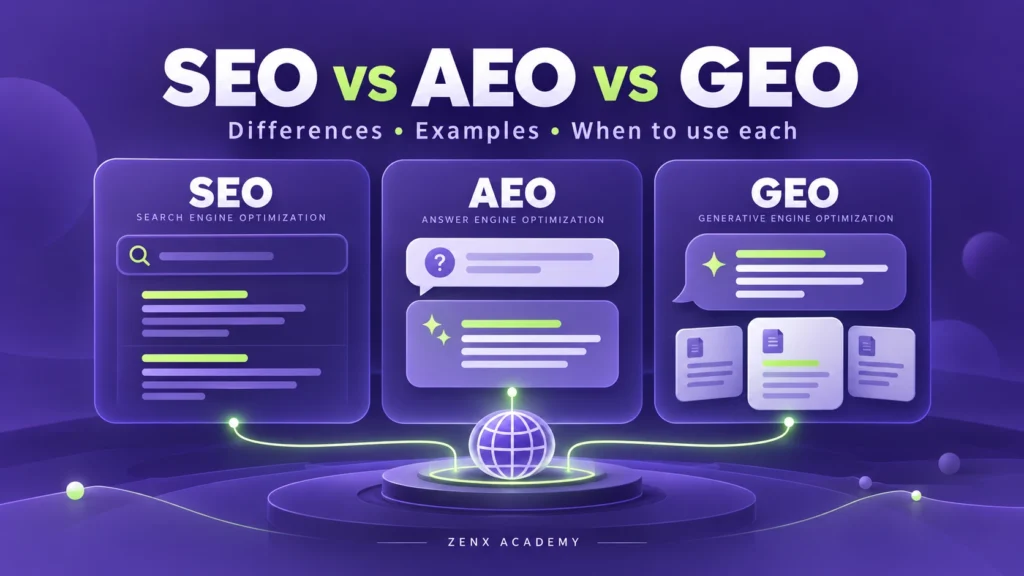
Direct answer: SEO improves discoverability across search experiences; AEO focuses on answering specific questions clearly; GEO focuses on visibility in generated responses. They overlap in technical access, useful content and evidence. Use them together, choosing priorities from your audience’s questions, website problems and measurable business goals.
The practical question behind SEO vs AEO vs GEO is where to spend your next hour of marketing work. Should you fix a website, rewrite a confusing explanation, or check whether an AI answer cites your business? Different problems need different actions, even when an agency uses the same label for all three.
This guide helps students, freelancers and small business owners compare the approaches through one shared decision framework. Official sources were checked on 2 October 2026. All business examples are hypothetical teaching scenarios, rather than ZenX Academy campaign results or predictions of search performance.
What is the quick comparison of SEO, AEO and GEO?
Quick summary: Start with a useful, accessible website. Improve answers where readers need explanations. Observe generated responses when those experiences matter to your customers. These are connected responsibilities, and a new acronym alone does not justify buying another service or publishing another page.
| Criterion | SEO | AEO | GEO |
|---|---|---|---|
| Main emphasis | Discoverability and useful search journeys | Answering a defined question clearly | Visibility and accuracy in generated responses |
| Content priority | Pages that satisfy the searcher’s task | Self-contained answers with enough context | Inspectable facts, evidence and coherent comparisons |
| Shared foundation | Accessible, accurate, useful website content | Accessible, accurate, useful website content | Accessible, accurate, useful website content |
| Example task | Clarify a service page and navigation | Explain what a service visit includes | Observe how a generated comparison describes the service |
| Evidence to report | Search observations, visits and business actions | Observed answers and supported source passages | Mentions, citations, accuracy and referrals |
| Important limit | No guaranteed indexing or ranking | No guaranteed chosen answer | No guaranteed citation or generated wording |
The table is a qualitative planning aid, not a map of three independent ranking algorithms. A single page can serve a normal search result, answer a specific question and support a generated response. The priorities below help you identify its weakest part before deciding what to change.
What does SEO mean beyond ranking a blue link?
Search engine optimization helps engines understand a website and helps people find useful information through search. Google’s SEO Starter Guide explains this relationship and makes clear that there is no secret that automatically puts a site first. Discovery, indexing and selection are separate stages.
For a hypothetical Chennai repair business, SEO work might begin with an accessible service page, a descriptive title, accurate service areas and a usable booking route. A beautifully written answer about repairs has limited practical value if visitors cannot find the page or understand whether the business serves their location.
SEO also includes matching the page to its purpose. Someone looking for a repair appointment needs different information from someone learning how an appliance works. The first page should help assess availability and next steps; the second should explain the problem safely and thoroughly. A keyword match cannot compensate for the wrong reader experience.
What does AEO mean when a reader needs a direct answer?
Answer engine optimization is a useful working label for improving how information addresses questions. In this guide, its focus is the quality and clarity of the answer: a definition, comparison, procedure or limitation that a reader can understand without decoding promotional language. The term also overlaps with broader AI search optimization.
A hypothetical training provider might receive the question, “Can a beginner learn SEO without coding?” A useful page would explain which tasks require no development work, where technical help becomes useful and what a beginner should practise. It would avoid turning the answer into a promise that everyone can master every task immediately.
Direct answers can appear in several interfaces. Google’s featured snippet documentation describes answer boxes selected by its systems; publishers cannot mark a page as the chosen snippet. Our practical AEO guide covers the detailed answer improvement process. Here, the decision is when that work deserves priority.
What does GEO mean in generated search responses?
Generative engine optimization concerns visibility in responses produced by generative systems. The original GEO research paper, first submitted in November 2023 and revised in June 2024, introduced an optimization framework and visibility measures for generative engine responses. Its research setting does not establish universal rules for every current commercial service.
The practical distinction is that a response can combine information from several sources instead of presenting only a ranked list of pages. A marketer should therefore examine what a response says, which source it references and whether the cited page actually supports the statement. A brand name appearing somewhere in a paragraph is a different observation from an accurate citation.
Consider a hypothetical buyer comparing two software categories. Your page may contain a strong explanation of the tradeoffs, but an answer could cite another source, omit your brand or describe your offering incorrectly. GEO-oriented observation records those outcomes and identifies factual gaps to investigate. It does not give a publisher control over the generated wording.
How do SEO, AEO and GEO overlap in Google Search?
Google’s current guidance for generative AI search explicitly treats work labelled AEO and GEO as SEO from its perspective. Its AI features use core Search ranking and quality systems. Useful original content and technical clarity remain relevant; special AI text files and special schema are not requirements for visibility.
This matters when evaluating a proposal that separates “traditional SEO” and “AI optimization” into unrelated packages. Ask which specific pages, technical problems, evidence gaps and reporting tasks each package covers. Separate prices may reflect different work, but separate names do not demonstrate that the underlying work is independent.
A practical shared foundation is one accurate source page per genuine reader task. It should explain its subject, provide the relevant facts, connect to supporting information and help a visitor act. Avoid publishing three near-identical versions simply to place SEO, AEO and GEO in different titles. That makes maintenance harder without adding a distinct reason to visit.
Which optimization approach should you prioritize first?
Prioritize the problem you can demonstrate. If an important page is inaccessible or its purpose is unclear, start with website discovery and usability. If readers repeatedly ask a question the page never answers, prioritize answer quality. If a generated response misstates a documented fact, investigate the source information and the observed response.
For a new website, a sensible first deliverable is a small set of complete pages with accurate contact details, clear offerings and working navigation. For an established educational blog, the useful next deliverable might be one improved explanation with a dated source. For a business already receiving AI referrals, a documented visibility review may be worth adding.
These examples are editorial prioritization advice, not measured return estimates. Explain your reason in plain language: “Customers cannot check eligibility” or “The service page omits the area served.” That is a better brief than “We need GEO because it is the newest trend.” Review the priority when new evidence appears.
How can one service page support all three approaches?
Imagine a Chennai home services business with a page for water purifier maintenance. The existing copy says only that the team provides excellent service at competitive prices. A visitor cannot tell what is included, which areas are covered or how to ask about a particular machine.
The SEO-oriented improvement is a clearly identified service page connected through the website’s navigation. The AEO-oriented improvement is an answer to actual questions: what a routine visit covers, what the customer should describe when booking and which charges require a quote. The GEO-oriented improvement is maintaining consistent, inspectable facts and recording how relevant generated responses describe them.
The team could replace unsupported claims with a dated service checklist, approved location details and a clear enquiry process. It should distinguish a standard visit from replacement parts, and describe any conditions that genuinely apply. One coherent page now helps several discovery journeys. None of these edits proves a future ranking, citation or enquiry.
How should an educational article handle comparison questions?
A comparison page needs shared criteria before it needs persuasive language. Suppose a student asks whether to learn technical SEO or content strategy first. A useful answer compares the tasks, prerequisites, sample exercises and circumstances in which each skill becomes useful. It also identifies where the two work together.
An AEO approach would make the immediate decision understandable. A GEO observation would check whether generated answers describe those distinctions accurately and whether the source they cite supports them. SEO work would make the comparison discoverable and connect it to deeper resources. The same page should serve a reader who arrives directly through a shared link.
Keep definitions stable throughout the comparison. If “beginner friendly” means no programming prerequisite, state that criterion rather than treating it as a universal quality rating. If the answer depends on a person’s current role, show how the recommendation changes. A decision table with explicit conditions is more useful than an unexplained winner.
Which content changes improve answer usefulness without adding filler?
Start with questions that expose missing information. Ask what a reader must know before making a decision, what could lead them to misunderstand a claim and which conditions change the answer. Then improve the existing page with the smallest complete explanation that resolves those gaps.
For example, a course comparison that lists only module names needs an explanation of what learners will actually practise. A service comparison that lists only prices needs comparable inclusions and dates. A technical guide that lists steps needs the prerequisites and a way to recognize when professional help is needed. Adding the acronym GEO to those pages would solve none of these problems.
Clear formatting is helpful for people, but paragraph length is not a universal ranking formula. Put the short answer near the question, then preserve the context needed to understand it. Use a table when the criteria are parallel, and ordinary paragraphs when the explanation depends on sequence or judgment.
What technical access checks matter for Google and ChatGPT?
Google’s AI features documentation says supporting pages must be indexed and eligible to show a search snippet. Its newer Search generative AI control documentation also describes inclusion controls in Search Console. Review the current control and applicable property inheritance rather than assuming a robots.txt edit resolves every issue.
For ChatGPT, OpenAI’s crawler documentation distinguishes OAI-SearchBot, used for search, from GPTBot, associated with training. Decisions about those purposes should be made independently. Permitting a crawler does not establish that a page will be selected, cited or described accurately.
Use a short diagnostic sequence: confirm that the intended public URL loads, inspect any indexing restrictions, check relevant crawler access and verify that important text is actually present. Keep a record of what you observed before changing settings. Our ChatGPT search optimization guide provides the platform-specific workflow when that is your chosen next task.
How should you measure SEO and AI answer visibility separately?
Choose metrics that match the question being asked. Search impressions describe exposure under the reporting system’s rules. Visits describe recorded arrivals. Enquiries describe a business action. A source citation describes a reference in an observed response. They can be related without being interchangeable.
Google’s Generative AI performance report documentation currently describes impression reporting for AI Overviews and AI Mode, with dimensions such as pages, countries, devices and dates. Check the report available to your property and its definitions. Do not assume it provides a complete cross-platform picture or a universal AI ranking position.
For a manual response review, record the exact question, date, engine, context, cited URL and accuracy of the supported statement. OpenAI’s ChatGPT search help explains source inspection and warns that results and citations can be incomplete or incorrect. Inspect the source before counting a reference as useful evidence.
A hypothetical monthly review could show improved clarity on a landing page alongside an unchanged enquiry count. That is a reason to investigate the next bottleneck, not to declare failure or invent revenue attribution. Compare comparable periods, note major site changes and describe what the available records cannot establish.
How can a small team run a practical four-week experiment?
In the first week, select one important page and one reader decision. Record the existing content, accessibility checks and available search or referral observations. Keep the scope narrow enough that someone can explain the problem without referring to an acronym. Choose a real business action to monitor, such as a relevant enquiry.
In the second week, improve the page’s missing facts and explanations. Agree who can approve offering details, remove obsolete information and use supported statements. In the third week, check the published page and begin a consistent observation log for the selected questions. In the fourth week, review what changed and what remains uncertain.
This is a suggested project schedule, not a promise that search systems will respond within four weeks. If the site is new or traffic is small, observation may need longer. Preserve the first version and the change dates so the team can distinguish completed work from an inferred effect. Extend a useful experiment rather than multiplying unsupported success claims.
What should students and freelancers ask before buying an AEO or GEO service?
Ask for the actual deliverables: the pages reviewed, problems identified, proposed edits, source verification process and reporting definitions. A sound proposal should explain what the provider can change and what remains controlled by the platform. Require a clear boundary between completed optimization work and promised visibility outcomes.
If a report shows a citation percentage, ask which questions were tested, how often, in which contexts and what counted as a citation. If a package includes content production, ask how duplicate topics are prevented and who verifies the claims. If it includes technical changes, ask how settings will be documented and approved.
A student can use the same questions when building a portfolio. Show an original page audit, an improved explanation, an evidence record and a careful measurement plan. These demonstrate judgment more clearly than a certificate-style claim to have mastered a secret ranking formula. Choose learning that makes those practical tasks understandable.
Which SEO, AEO and GEO mistakes should you avoid?
Avoid treating every brand mention as a recommendation, every citation as a visit and every visit as a customer. Also avoid replacing reliable explanations with keyword-heavy sentences that people find harder to read. A meaningful report states both what was observed and what the observation cannot prove.
Do not invent testimonials, independent coverage or source material to influence answers. Do not add structured data that describes offers, reviews or credentials absent from the visible page. When information changes, update the facts and supporting evidence rather than changing only the year in the title.
The most useful review question is simple: does this edit help a reader understand or complete the task? If the justification depends entirely on a supposed undisclosed algorithm trick, demand stronger evidence. Maintain a short list of agreed facts and owners, and check it before publishing another comparison or service claim.
What is the sensible next step for learning integrated search optimization?
Choose one existing page and practise the complete process: establish its reader task, inspect access, improve the answer, verify the evidence and describe measurement limits. Explain why each change belongs in the project. The result should be a clearer page and an auditable work record.
For learners exploring structured training, review the ZenX Academy AI digital marketing curriculum and ask the academy about current modules, project feedback and eligibility. ZenX publishes this guide and has a commercial interest in its training. No course fee, placement promise or guaranteed search outcome is asserted here.
Does GEO mean geographic targeting or generative engine optimization?
In this article, GEO means generative engine optimization: work concerned with visibility in generated responses. Geographic targeting is a separate marketing concept. Check the surrounding context, because the same abbreviation can mean different things in other documents.
Should a new website learn SEO before AEO and GEO?
Start with a useful, accessible website and clear explanations of its purpose. Practise answering real questions alongside those foundations. Add generated-response observation when it serves a defined audience need, rather than postponing good content until every technical lesson is complete.
Are AEO and GEO standardized industry certifications?
These labels describe overlapping areas of marketing work, not a universal certification standard. Evaluate a provider’s actual curriculum, assessment and evidence. A course title alone does not establish recognized accreditation, platform approval or a verified level of professional competence.
Can one page work for SEO, AEO and GEO together?
Yes. One page can be discoverable through search, answer a reader’s question and provide useful source material for generated responses. Give it a clear purpose, accurate facts and relevant context, then measure each observed outcome using its own definition.
Do I need separate agencies for each optimization approach?
Separate agencies are not inherently required. Evaluate whether your team can cover technical access, content quality, evidence and reporting. If several providers participate, define responsibilities clearly so that overlapping packages do not create contradictory edits or duplicate measurement claims.
Does a citation in an AI answer guarantee website traffic?
No. A citation is an observed reference, while traffic requires a recorded visit. Inspect whether the cited page supports the answer, then review available referral data separately. Neither observation alone proves that a visitor became a qualified customer.
Will FAQ schema guarantee inclusion in generated answers?
No. Structured data should describe information visible on the page and suit its actual content. FAQ markup is not a guaranteed route to AI citations or search features. Prioritize useful answers and verified facts over unsupported schema promises.
Is there a fixed budget split for SEO, AEO and GEO?
There is no universal percentage split that fits every website. Allocate work according to demonstrated problems, audience behavior and available evidence. Document priorities and review them over time instead of accepting a budget formula without a clear business rationale.
Can Tamil content follow the same comparison framework?
Yes. Start with the reader’s language and decision, then provide accurate explanations and relevant evidence. Maintain natural Tamil wording and clear source context. Test actual questions where useful, while recording language and platform conditions rather than assuming equivalent exposure.
How long does integrated search optimization take to show results?
The timing depends on discovery, competition, website history and the changes made. Record the publication date and observation period, then assess comparable evidence. A suggested project schedule describes work you can complete, not a guaranteed deadline for rankings or citations.
Which sources and examples support this comparison guide?
Sources linked beside the relevant claims include Google Search Central guidance, Google’s Search Console help, OpenAI’s search and crawler documentation, and the original GEO research paper. Checked 2 October 2026. The comparison table and business scenarios are editorial teaching aids, not benchmark datasets or reported client outcomes.
Explore seo, aeo & geo
Understand search optimization approaches, then explore answer engines, ChatGPT visibility and Google Search changes.