Direct answer: Google Search updates in 2026 include confirmed ranking rollouts and changes to search reporting. As checked on October 1, the latest listed ranking announcement is the September spam update. SEOs should verify official dates, examine affected pages, and distinguish algorithm changes from measurement changes.
A traffic dip, a new report and an algorithm announcement can arrive in the same week. They require different responses. This guide helps students, freelancers and website owners identify what Google actually announced, decide which evidence to collect, and plan useful improvements without treating every movement as a penalty.
Freshness note: Official sources checked on October 1, 2026. This article was published early from our October 3 editorial slot. It does not predict announcements after the checking date. Dashboard event times use US/Pacific; compare them carefully with your own reporting timezone.
Quick summary of confirmed Google Search changes in 2026
The immediate priorities are straightforward: monitor the September spam rollout, review relevant spam policies, and check the newer reporting options available in your own account. A reporting feature describes visibility; its release does not by itself prove that ranking systems changed.
Key takeaways: Keep announcement dates separate from completion dates. Diagnose individual page groups before rewriting the whole website. Preserve an evidence record for every change. Judge success through reader usefulness and business outcomes as well as search visibility.
Which official sources should you check for Google algorithm updates?
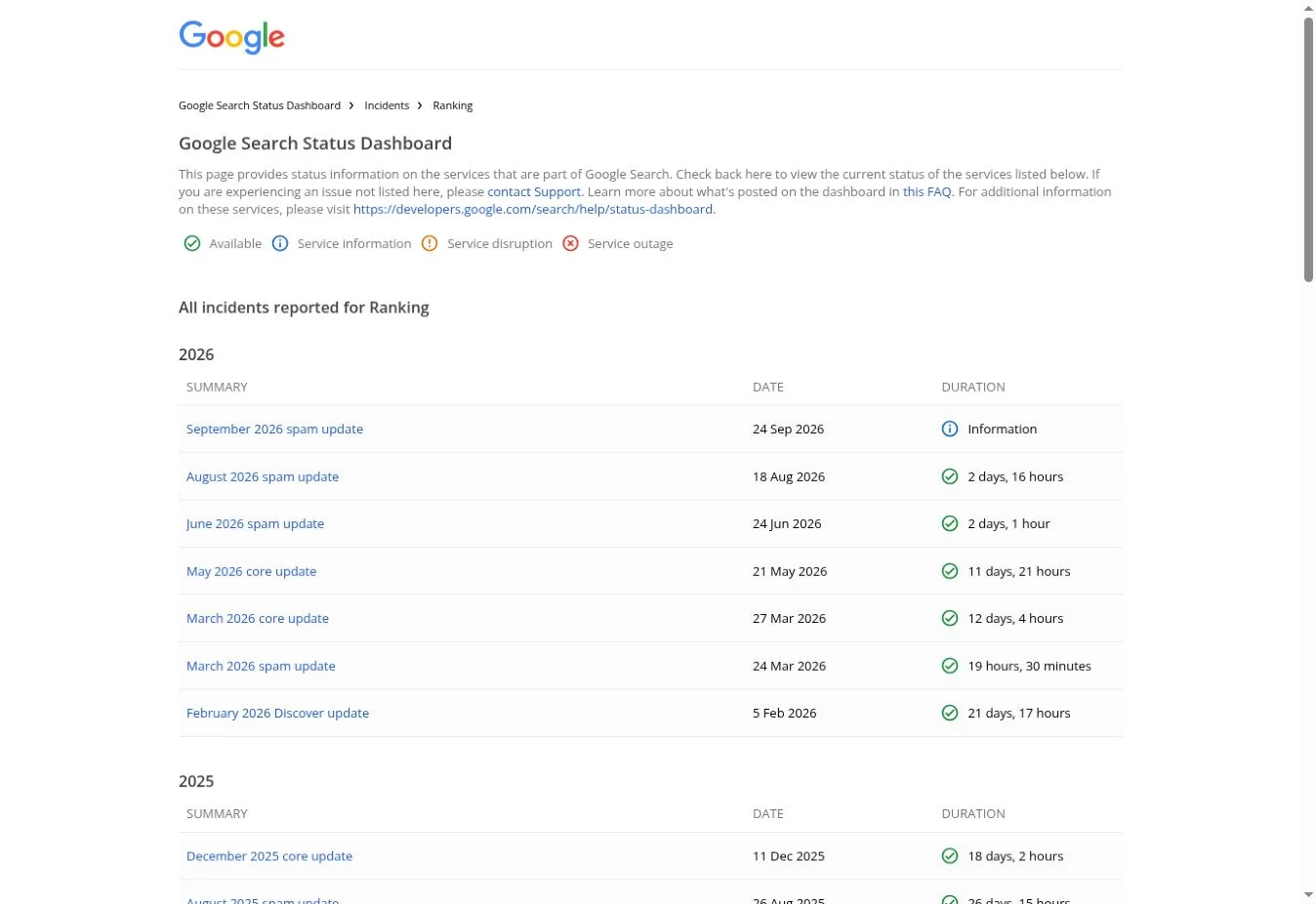
Use the Google Search Status Dashboard ranking history to identify confirmed rollouts. At this check it lists September, August, June and March spam updates, May and March core updates, and a February Discover update for 2026.
The Google Search Central blog provides reporting announcements and explanations. Its documentation update log provides a separate record of documentation changes. Record the source type before deciding whether an item belongs in an algorithm timeline, a reporting checklist or a technical maintenance task.
An agency should maintain one short evidence note per event: official name, announcement URL, start date, completion status, checking date and affected service. Add observed changes to another field. Keeping the announcement and your own observation separate prevents a client report from implying that correlation establishes cause.
What is the latest confirmed Google spam update as of October 1?
The September 2026 spam update announcement records a September 24 start at 09:15 US/Pacific. Google says it applies globally and across languages, with a rollout that may take up to two weeks. The incident page retrieved for this article did not include a completion notice.
For a Tamil or English website, global and all-language scope means the announcement is relevant to monitor. It does not establish that your particular site was affected. Avoid telling a student or client that a page has been penalized solely because clicks declined after September 24.
Create a watchlist of your important landing pages, record their recent edits, and keep comparable observations while the rollout continues. Fix an obvious broken page immediately; do not delay a needed technical repair because an update is running. Keep speculative content changes separate from those repairs.
How do recent spam updates differ from the May core update?
The August 2026 spam update record shows a rollout from August 18 to August 21. The May 2026 core update record shows a May 21 start and June 2 completion. These are separate confirmed events.
According to Google’s explanation of core updates, core changes broadly reassess helpful and reliable results rather than targeting a particular website. Google recommends waiting at least a full week after completion before comparing relevant Search Console periods.
Google’s spam update guidance concerns improvements to spam detection and advises reviewing its policies. Choose the investigation according to the event and the actual page evidence. A broad quality review and an investigation into manipulative behavior answer different questions.
| Change type | What to verify | Useful next action |
|---|---|---|
| Core ranking update | Rollout completion and affected pages | Review usefulness and compare stable periods |
| Spam ranking update | Official scope and possible policy issues | Audit actual content and link practices |
| Search reporting feature | Metric definition and account availability | Review measurement and retain comparable exports |
| Technical site problem | Access, redirects and indexability | Repair the verified fault and document it |
Which spam-policy issues should an SEO audit investigate?
Google’s web search spam policies describe practices including scaled content abuse, doorway abuse and link spam. Scaled abuse concerns producing many pages primarily to manipulate rankings without helping users, whether those pages are made by people, automation or a combination.
Use a practical page review rather than a label based on the writing tool. Can the visitor complete a real task here? Does the page add specific information? Are claims supported? Would a separate page still be useful if it could not send the visitor to the main sales page?
Hypothetical example: a training business publishes twenty city pages with identical advice and only replaces the city name. An editor should assess whether each page contains meaningful local information and serves a distinct need. A useful regional guide may solve the reader’s task better than another near-identical page.
For links, inspect how the relationship arose and what benefit the linked resource provides. Keep a record of paid placements, exchanges and repeated promotional anchors. Do not assume that a third-party score diagnoses a Google action. Investigate the real practice and the relevant policy before proposing a fix.
What changed in Search Console multimodal reporting in September?
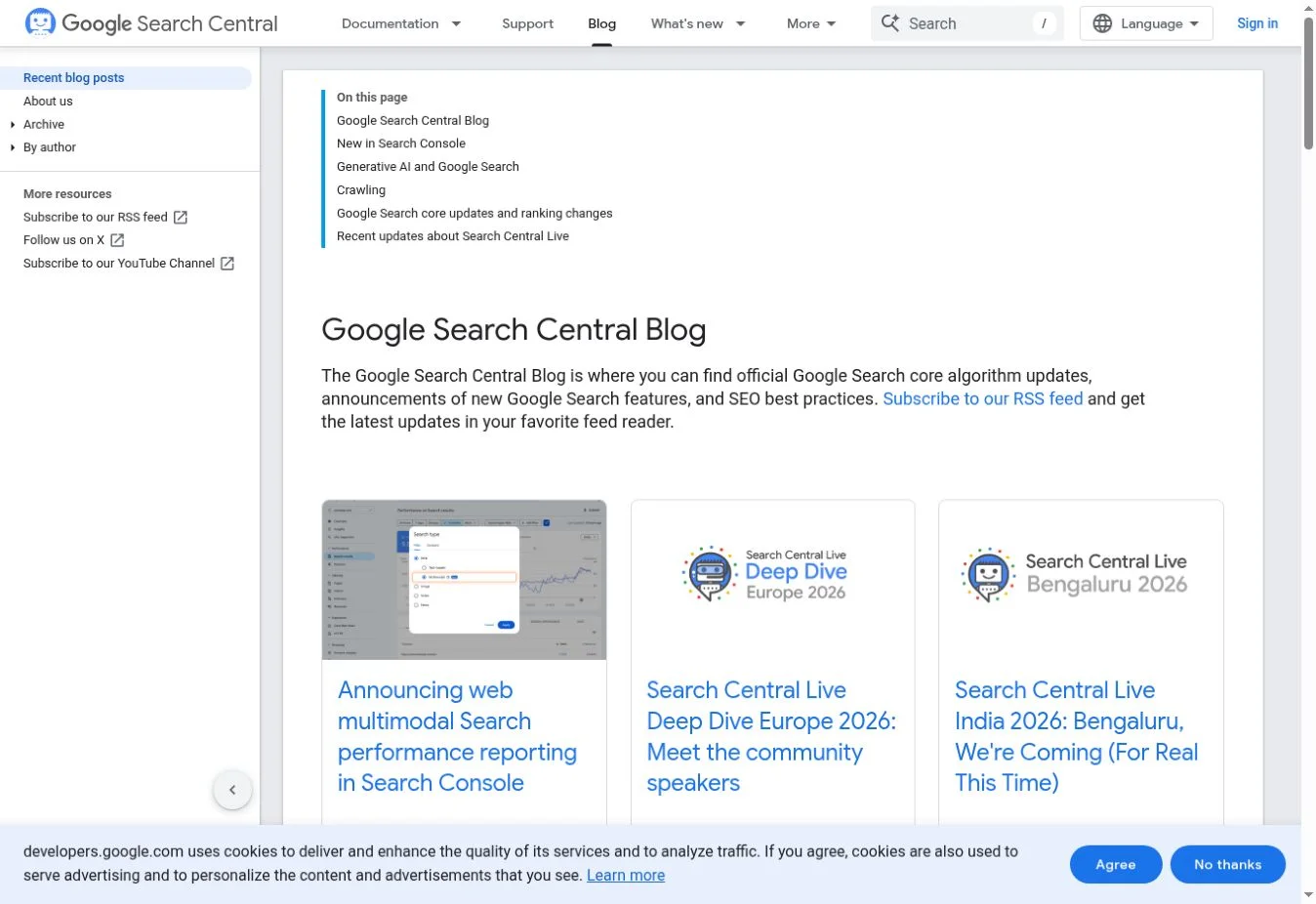
On September 24, Google announced multimodal search reporting for Search Console performance reports, including its generative AI reporting. It covers image-led searches such as Lens, Circle to Search, uploaded images and browser image search. Google says rollout began globally and data appears for sites receiving those queries.
For a business owner, the practical opportunity is to separate this discovery route from ordinary typed searches where the account supports it. Check the available filter and its definition before exporting. A screenshot of the public announcement cannot establish that a particular website has traffic in that report.
Hypothetical example: a coffee retailer has original packaging photographs and detailed brewing instructions. Its marketer can review whether relevant visual-search traffic is present, inspect the landing pages, and improve explanations beside the photos. This is an investigation plan, not evidence of an automatic ranking benefit.
How do the 2026 generative AI performance reports affect SEO measurement?
Google’s June 3 generative AI reporting announcement describes dedicated visibility reports for Search and Discover. The page includes an August 31 note stating worldwide rollout to websites. It describes impressions, pages, countries, dates and, for Search, devices; the overall performance report still includes this visibility.
Use the report’s current definitions when building a dashboard. An impression represents exposure under the report’s counting rules. It is different from a referral visit, a qualified enquiry or revenue. Do not turn an impression count into a claim about citations in every AI service.
Keep the total view and the specialized view side by side, documenting which dimensions and dates each uses. If two exports overlap, avoid adding them together as independent audiences. For introductory concepts and examples, read our beginner guide to answer engine optimization.
Why do social and video reporting updates belong in a separate checklist?
Google’s July 29 platform properties announcement states that these properties became globally available and describes a guide for analyzing social and video content performance on Google surfaces. This is a reporting development, distinct from a confirmed core ranking rollout.
A creator should compare like with like. Search visibility for a social post is different from that platform’s native engagement and different again from website conversions. Put the source and destination beside every metric, so a client can understand what action a reported click actually represents.
For example, a hypothetical Tamil educator might discover that one tutorial continues attracting search visitors while another produces more website enquiries. Those observations suggest different editorial follow-ups. Record both before deciding to expand a topic, change a caption or produce a second lesson.
Do Google AI search changes require a separate ranking formula?
Google published a new generative AI optimization resource on May 15. Its official optimization guide explains that foundational SEO remains relevant and rejects the need for special AI files or markup for Google Search visibility. It also emphasizes useful original information and technical access.
Our recommendation is to define a specific editorial improvement rather than promise a hidden formula. Replace an unsupported claim with a precise explanation and evidence. Add a useful demonstration where the reader needs one. Consolidate redundant explanations within the same article when that makes navigation easier.
Hypothetical example: instead of publishing six pages that repeat how to write a meta description, a student can create one guide with a service-page example, a product example, a revision exercise and a clear explanation of limitations. The benefit is a better learning resource, not a guaranteed AI citation.
How should you diagnose a traffic drop before changing content?
Google’s traffic-drop troubleshooting guide identifies several possible causes, including technical faults, ranking changes, seasonality and reporting issues. Start with the shape of the decline and compare relevant search types and page groups. A single total conceals important differences.
First, write the question being investigated: “Did non-brand search visibility decline for our course pages?” is more useful than “Did SEO stop working?” Define the dates, geography, device scope and page set. Keep those choices constant when you compare exports.
Next, compare the report with your deployment history. A changed URL structure, accidental access restriction, template problem or broken tracking setup belongs in the timeline. Look for a concrete fault before attributing the whole pattern to the latest announcement. Record competing explanations until the evidence supports narrowing them.
Finally, separate visibility from response. Falling clicks alongside similar impressions may prompt a review of query mix and search presentation. Fewer enquiries despite similar visits prompts a review of landing-page experience and measurement. These are working hypotheses; validate them with the relevant data rather than presenting them as conclusions.
What should a Chennai business do during its first update review?
Hypothetical example: a Chennai training business notices fewer course enquiries. The owner wants to rewrite all blog titles. An analyst should first ask whether the decline appears in search exposure, visits, form submissions or only the CRM count. Each answer changes the investigation.
Build a small table of the main course page, three supporting guides and the enquiry destination. Add the reader task, recent change date, observed issue, evidence needed and proposed owner. This produces a reviewable plan without creating dozens of tasks from one untested assumption.
Read the pages on a phone. Can a student locate the syllabus, distinguish examples from promises and understand the next step? An actual usability problem deserves a repair even when its relationship to the algorithm is unknown. Explain the benefit in those concrete terms.
When a tool could save time, choose it for the investigation you need to perform. Our AI SEO tools comparison helps distinguish research, technical checks and content workflows. Software can organize evidence; the analyst still needs to interpret the page and its audience.
How can students practise an evidence-based Google update audit?
Create a classroom exercise with one confirmed announcement and a hypothetical website. Ask each student to produce three documents: a source note, a page review and a proposed change. A good answer identifies what is known, what remains uncertain and what the next observation would resolve.
Useful research prompt: “Summarize this official announcement. Separate its event date, publication date, scope and completion status. Quote no unsupported ranking factors. List the claims I must verify before using it in a client report.” Supply the official page content and check the output against it.
Useful audit prompt: “Review this public page for the reader’s stated task. Identify unsupported claims, missing decision information and duplicated sections. Recommend five specific edits, with the reader benefit and evidence needed for each. Label hypothetical examples and avoid predicting ranking improvements.”
Useful reporting prompt: “Using only these anonymized observations, write a short update with confirmed facts, possible explanations and next actions. Do not claim the algorithm caused a change unless the evidence supports that conclusion. State which measurements are missing.” Remove private client details before using any external service.
For guided learning, explore the verified ZenX Academy digital marketing course page and ask about current curriculum details. Practise source checking, page analysis and honest reporting before promising outcomes to a client.
Which actions belong in a practical seven-day SEO response plan?
Day one: capture the official announcement and your current baseline. Day two: inspect affected page groups and recent site changes. Day three: verify suspected access or measurement faults. Resolve an urgent confirmed fault when it is found rather than waiting for the rest of the exercise.
Day four: review a small group of important pages for missing information and unsupported claims. Day five: prepare changes with a clear reader benefit. Day six: apply the approved work and verify its rendering, links and media. Day seven: record the outcome and the next review date.
This is a suggested operating rhythm, not Google’s recovery timetable. Use longer observation periods when the data is sparse or a rollout remains active. Keep one change log so future reviewers can distinguish the content edit from a simultaneous template repair or reporting change.
End the review with a decision that another person can assess: maintain, improve, investigate further or recommend consolidation. Explain the evidence and limits beside that decision. A precise small improvement is easier to evaluate than a broad promise to recover every keyword.
What is the latest confirmed Google ranking update in this article?
As checked on October 1, 2026, the dashboard’s latest listed ranking announcement is the September spam update, started September 24. Its retrieved incident page did not yet show completion. Check the official record for subsequent changes.
Does a traffic drop during a spam update prove a penalty?
No. Timing alone cannot establish why a page lost traffic. Compare page groups, query patterns, technical changes and measurement behavior. Use the official announcement as context while collecting evidence about the actual website and its affected pages.
Should I rewrite every blog during a core update?
Start with an evidence review and a small set of important pages. Identify specific missing information or usability problems before editing. Preserve useful content, document changes and choose an observation period that allows a meaningful comparison afterward.
Are reporting changes the same as Google algorithm changes?
A reporting change affects how visibility is displayed or analyzed. A ranking update concerns search systems. Keep these event types separate in your timeline, and read the announcement before attributing a traffic pattern to an algorithm change.
Can Tamil websites be affected by the September spam update?
Google’s announcement says the September update applies globally and to all languages. Tamil websites therefore fall within its stated scope, but that does not prove an individual site was affected. Inspect actual page and search evidence before concluding.
Do generative AI impressions measure enquiries or sales?
They measure exposure under the report’s definitions, not business outcomes. Track visits, qualified enquiries and sales separately with appropriate measurement. Avoid adding overlapping reports together or presenting a visibility count as proof of revenue from a particular change.
Must I add llms.txt to respond to Google Search updates?
Google’s guidance says special AI files are not required for its search visibility. Prioritize useful information and technical access. Other services may use different conventions, so evaluate their documented requirements separately before adding work to your maintenance plan.
How long should I wait before comparing a completed core rollout?
Google advises waiting at least a full week after a core update completes before assessing relevant Search Console comparisons. Select comparable periods and inspect important pages. Sparse data or seasonal demand can require additional context and longer observation.
Should I delete pages that have low search traffic?
Low traffic alone is insufficient. Review the page’s purpose, usefulness, conversions, audience and relationship to other pages. Improve a useful resource when appropriate; recommend consolidation only after comparing content and intent, with a deliberate plan for affected URLs.
What evidence should a freelancer include in an update report?
Include official source URLs, checking dates, rollout status, page observations, measurement scope and a change log. Separate facts from hypotheses and record missing data. Recommend specific next actions without guaranteeing recovery, rankings, AI citations or client revenue.
Official sources and scope of this Google updates guide
Sources include Google’s ranking incident records, Search Central announcements and documentation, linked beside the relevant claims above. All were checked on October 1, 2026. Classroom exercises, business examples and the seven-day plan are original editorial recommendations; they are not measured ZenX case studies.
This guide focuses on decisions after confirmed announcements. It is not a complete archive of every Google product release. Recheck ongoing incident records and current report definitions before using the article for a later client review.