


Direct answer: To improve your chances of appearing in ChatGPT search, make public pages accessible to its search crawler, answer real questions clearly, support claims with evidence, and measure citations and referral visits separately. No checklist guarantees a position, mention or citation; these 15 strategies provide a practical improvement process.
People searching for how to rank in ChatGPT usually want their business, article or service to appear when someone asks a relevant question. The useful goal is discoverability followed by an accurate, helpful answer and a worthwhile visit. Treating every generated response as a fixed results page makes measurement confusing.
This guide is for students, freelancers and small business marketers who can improve a website and document the outcome. Official platform guidance was checked on 2 October 2026. The strategies below are editorial recommendations, not a disclosed list of algorithm weights or evidence of ZenX Academy campaign results.
What does ranking in ChatGPT search actually mean?
ChatGPT search can return answers with links to sources. OpenAI’s search guidance describes multiple factors aimed at relevant, reliable information and explicitly says placement is not guaranteed. A marketer should therefore define the specific outcome before claiming a ranking improvement.
A brand mention means the answer names a business. A citation connects information to a source. A referral visit means someone reaches the website. An enquiry means that visitor takes a business action. These outcomes are related but not interchangeable: a citation can exist without a visit, and a visit can arrive without a qualified enquiry.
Quick summary: Start with access, then improve information, then observe results. Choose a small group of buyer questions and useful pages. Keep a dated record of changes. Measure a sample honestly instead of claiming universal visibility from one favorable answer.
For the broader definition and beginner examples, read our answer engine optimization guide. This article adds a ChatGPT-specific implementation and observation plan rather than repeating the general AEO introduction.
1. Define the questions your target customers ask ChatGPT
Build a question set around real decisions. An informational question asks what something means; a comparison question asks which option suits a need; a local question introduces a place; a purchase question asks about availability or conditions. One generic prompt cannot represent all four situations.
For a hypothetical Chennai training business, separate “What skills does an SEO beginner need?” from “Which Tamil marketing course includes practical SEO projects?” The second needs verified delivery details and evaluation criteria. Record the audience, language, geography and intended destination for each question before commissioning content.
Use a modest, fixed question sample for monitoring. Adding favorable prompts after seeing results makes the comparison unreliable. Keep broad questions and brand-specific questions in different groups, because naming your own company in the question can influence what the answer discusses.
2. Check OAI-SearchBot access before changing content
OpenAI’s crawler documentation distinguishes OAI-SearchBot for search from GPTBot for potential model training. Their controls are independent. Allowing training-related crawling is not a documented requirement for search discovery. ChatGPT-User represents certain user-triggered visits and is not the search eligibility control.
Ask the website owner or developer to review robots rules for the public pages that should be discoverable. Check the deployed file, the applicable user-agent group and specific path rules. A general allow rule can coexist with a more specific restriction, so inspect the actual configuration rather than copying a snippet blindly.
Preserve restrictions on private accounts and sensitive material. Document which public paths are intended for discovery and why. This is an access review, not evidence that the article has been indexed or selected for an answer.
3. Verify hosting and security access for search crawlers
A page that opens in your browser may still be inaccessible to a crawler. Have the technical owner inspect server logs, security challenges and failed requests for the intended public URLs. Use the published searchbot IP information in the official guidance when evaluating access; a user-agent string alone is insufficient proof of identity.
Keep the review narrow. Investigate the relevant page, request time, response status and any challenge served instead of disabling protection across the whole website. If an intended public resource is blocked, make a documented adjustment through the hosting provider’s supported controls and check the resulting behavior.
Retain both the problem and the verification record. “A security rule changed” and “the relevant request succeeded” are different statements. Neither establishes a citation, and a successful request to the homepage does not establish access to every article.
4. Make important information readable on the public page
Inspect the page without editing permissions. The main explanation should appear as readable text, with useful headings and descriptive links. Avoid placing the only definition, price condition or process explanation inside an image. Images can support the explanation, while the text should still make sense when viewed independently.
Check whether popups, collapsed sections or login requirements prevent an ordinary visitor from understanding the offer. A public article should deliver the promised information before asking for an enquiry. Use meaningful labels on navigation and forms so the next step is clear.
For a hypothetical course page, write the delivery mode, intended audience and verified inclusions in visible text. Separate current facts from promotional slogans. This makes the page more useful to people and easier to audit; it is not a claim about a hidden ChatGPT formatting score.
5. Write a direct answer with enough supporting context
Begin important sections with an explicit answer, then explain its conditions. A definition should say what the term means. A comparison should identify the deciding criteria. A process should state the goal and prerequisites before listing steps. Avoid making readers scroll through several promotional paragraphs to locate the promised explanation.
For example, a hypothetical section about choosing an SEO course could answer: “Compare practical tasks, feedback, delivery language and current inclusions before comparing fees.” Supporting paragraphs can explain how to check those items. This is more useful than an unsupported claim that one academy is universally best.
Use short paragraphs and descriptive headings because readers can scan them. There is no verified magic paragraph length in this guide. A short answer that removes essential conditions can mislead, so favor completeness over an arbitrary extraction formula.
6. Support important claims with inspectable evidence
Match the source to the claim. A feature statement needs current documentation; a price needs its billing terms; a performance result needs underlying observations and a method. Put the evidence near the relevant statement so a reader can check it without guessing which reference supports which claim.
Separate official product facts from your practical recommendations. A vendor page can show what a company offers, but it cannot independently prove superiority over every alternative. If a statement rests on an observation, record what was observed, when and under what conditions.
Remove claims you cannot substantiate. “We tested every tool” requires actual testing records. “Students obtained jobs” requires verified, appropriately presented evidence. Original diagrams and screenshots explain information but do not prove commercial outcomes. Honest limitations give readers a better basis for decisions.
7. Clarify your organization and author information
Help readers understand who is responsible for the page. Maintain a consistent business name, a useful About page and accurate contact details. Where an author is shown, use the real identity and relevant experience without inventing credentials, professional recognition or external affiliations.
Review conflicting descriptions across your own public pages. If one page says online classes and another implies a physical classroom, clarify the current arrangement. Consistency should improve factual accuracy rather than hide meaningful differences between services.
Treat these actions as trust and usability improvements. They do not create a guaranteed knowledge panel or make an author a recognized authority merely because a profile exists. For local services, describe the service area truthfully and avoid publishing superficial location pages with the same content.
8. Cover one decision thoroughly before multiplying pages
Choose the page that should own a question, then improve its substance. Include the definition, relevant choices, prerequisites, limitations and next step. A visitor should be able to complete the promised task without being redirected to a thin sales page for every useful detail.
Compare existing content before creating another article. A general AEO guide, a ChatGPT discovery workflow and a tool comparison can coexist when each answers a distinct question. Repeating the same list under slightly different keywords adds maintenance work and can confuse readers about the primary resource.
Our AI SEO tools comparison covers software selection. This guide covers what to improve and how to observe it. Choose software after defining the measurement requirement, not simply because a dashboard advertises an AI visibility score.
9. Use comparison tables with explicit criteria and limits
Tables help when a reader needs to compare consistent attributes. State the audience, the criteria and the checking date. Compare like with like: a basic plan and an enterprise package may serve different needs. If you cannot verify a value, identify the gap instead of filling it with an estimate.
For an educational example, compare “self-paced learning,” “live feedback” and “project review” as delivery characteristics rather than ranking providers without evidence. Explain why a characteristic matters to a particular learner. Someone needing feedback may make a different choice from someone revising familiar concepts independently.
The following qualitative table clarifies outcomes in this workflow. It contains no benchmark data or algorithm weights. Use it when reviewing reports so a mention, citation or referral is not incorrectly presented as another type of result.
| Outcome | What to record | What it does not prove |
|---|---|---|
| Brand mention | Exact question, date and named brand | A source citation or visitor |
| Source citation | Referenced URL and claim supported | A click or permanent placement |
| Referral visit | Recorded source and landing page | Total exposure or an enquiry |
| Qualified enquiry | Relevant business action and attribution method | The isolated cause of the action |
10. Connect relevant pages through descriptive internal links
Add a link when it answers the reader’s next question. A beginner definition can lead to a detailed workflow, and a practical workflow can lead to a relevant curriculum. Use anchor text that describes the destination instead of inserting a course link into every paragraph.
Check the actual destination and preferred URL before publishing. Avoid linking to drafts, redirect chains or a guessed path. Keep a small link register recording the source section, anchor, destination and reason. For this article, each internal or external destination is linked once.
Recommend reciprocal links from useful existing articles when appropriate, but make those edits deliberately. Linking is a navigational relationship, not a guaranteed transfer of AI citation authority. A network of similar low-value pages does not become useful simply because every page links to every other page.
11. Keep time-sensitive information genuinely current
Review the facts that can change: features, availability, course delivery, fees and contact methods. Mark the date on which they were checked. Update an article when its substance changes, and preserve the actual publication history rather than moving the date forward to imply a fresh review.
Create a maintenance queue with a reason for each review. A plan comparison may need a new check when the vendor changes its tiers. A technical walkthrough may need revision after an interface update. An evergreen definition may need fewer changes but should still be checked for outdated examples.
Keep a concise change log. “Updated the screenshot and corrected a crawler explanation” tells a reader more than “latest guide.” Freshness matters when the information is time-sensitive; changing the year in a title does not create new evidence.
12. Earn accurate independent coverage without manufacturing mentions
Create something other people can use: a documented method, an original resource, a transparent comparison or an explanation by a real specialist. Where you contribute to another publication, disclose relationships and provide facts the editor can verify. Independent coverage should arise from useful work, not fabricated recommendations.
Correct inaccurate public business descriptions through legitimate channels. Keep records of what was changed. Avoid buying fake reviews, posting invented discussions or creating pseudo-independent “best” lists that secretly promote your own organization without disclosure.
This is a reputation and evidence strategy, not a documented ChatGPT backlink formula. External coverage may help people encounter your business, but an individual mention does not prove the platform will cite you. Evaluate the relevance and accuracy of coverage rather than counting every occurrence as a victory.
13. Use structured data that matches visible information
Inspect the markup your theme or SEO plugin already emits before adding another script. An editorial page can describe its real author, publisher, image and dates. Keep those values aligned with the visible page, and avoid duplicate objects that disagree about the canonical URL or publication date.
Validation has several levels. Valid JSON means the syntax parses. Schema vocabulary checks examine the chosen types and properties. A search feature may impose additional requirements. None of those checks alone proves that ChatGPT will cite the page or that a rich result will appear.
Do not add fabricated reviews, ratings or offers to an article. Visible FAQs can help readers without requiring a special search appearance. This guide uses structured information as a consistency check, not as a promised shortcut to AI visibility.
14. Observe citations, visits and enquiries separately
Create a dated observation log for your fixed question set. Record the exact wording, whether search was used, language, available location context, brand mentions, citations and the cited URL. Inspect the source to see whether it supports the answer. Keep the original observation rather than only a favorable screenshot.
OpenAI’s publisher FAQ says ChatGPT adds utm_source=chatgpt.com to referral URLs. Use your analytics setup to review those visits, while remembering that tracking limitations and user behavior can affect the recorded totals. A referral count is not a count of all answer exposures.
Report the sample denominator. Three citations in ten documented observations is a sample result, not a universal citation rate. Track qualified enquiries separately and describe the attribution method. Do not infer revenue or causation solely from an increase in mentions.
15. Improve pages through a documented experiment cycle
Start with one valuable page and a clear hypothesis. For example: “The page omits the prerequisites that appear in our buyer questions.” Add the missing explanation, record the date and keep other major changes limited when practical. Then repeat the same observation sample after an appropriate interval.
Compare like contexts and preserve uncertainty. Changes in prompts, timing, location, conversation context or search availability can affect what you observe. A before-and-after difference cannot by itself isolate the effect of your edit. Record plausible alternative explanations instead of declaring a new ranking factor.
Keep improvements that make the page more useful even when the small sample is inconclusive. The objective is a reliable information resource and better decisions, not endless prompt manipulation to obtain a favorable screenshot. Review technical access again if the page stops being reachable.
How can a Chennai business run a practical first-month experiment?
This hypothetical exercise uses one course information page and a small question set. In the first week, record the current page, verified offering details, access checks and initial observations. Identify one substantive gap, such as missing practical assignment examples. No real ZenX campaign outcome is implied.
In the second week, revise that gap with a clear explanation, useful evidence and a relevant next step. Check the mobile page, visible text, links, metadata and any existing structured data. Document what changed and preserve the earlier version for comparison. Avoid creating several near-identical articles during the same experiment.
In the remaining weeks, repeat the question sample and review referrals and qualified enquiries separately. If nothing changes in the observation sample, explain that limitation. If citations appear, verify the source and its relevance. Neither outcome justifies a guarantee about future answers.
For a learning pathway, review the ZenX Academy syllabus overview and ask the academy for current delivery details. Choose training based on tasks you want to practice, feedback needs and verified inclusions rather than an assurance of guaranteed rankings.
What should your ChatGPT search optimization checklist include?
Before publishing, confirm the audience question, intended page, readable answer and supporting evidence. Check that the public page opens, the canonical matches the intended destination, links work and media loads. Review crawler access with the technical owner without exposing restricted content.
After publishing, record the actual URL, publication date and change log. Inspect the live page, then maintain the question sample and analytics record. Keep a separate column for each outcome and a note for uncertainty. Use the evidence to prioritize improvements rather than turning a visibility score into a business guarantee.
Can a website guarantee first position in ChatGPT?
No. OpenAI states that placement is not guaranteed. Define whether you mean a mention, citation or referral visit, then document a repeatable observation sample. A favorable answer to one prompt does not establish a permanent position.
Does allowing GPTBot help me appear in ChatGPT search?
GPTBot concerns potential model training, while OAI-SearchBot controls search-related crawling. Their settings are independent in OpenAI’s documentation. Review your search access policy separately from training preferences, and avoid treating permission to train as a guaranteed visibility tactic.
Is a brand mention the same as a source citation?
No. A mention names a brand, while a citation points readers to a source. Record them in separate columns and inspect the cited page. Neither result by itself proves that a visitor arrived or made an enquiry.
How can small businesses start without paid AI visibility software?
Use a fixed question sample, a simple observation log and existing website analytics. Record citations and visits separately, then improve one useful page. Paid tools may help organize monitoring, but first define the decisions your report should support.
Can Tamil content appear in a ChatGPT search answer?
Evaluate Tamil questions and Tamil content in their own observation sample. Ensure the information is useful, readable and accessible, then record actual results. Do not infer visibility from an English test or promise citations solely because a translation exists.
Should I add llms.txt to rank in ChatGPT?
The official search access guidance reviewed here identifies OAI-SearchBot and hosting access; it does not establish llms.txt as a ranking requirement. Treat additional file conventions as experiments, and prioritize documented access checks and useful public content first.
Does FAQ schema guarantee ChatGPT citations?
No guarantee is supported by the guidance reviewed here. Visible answers can help readers, while structured data should accurately describe the page. Check existing markup before adding more, and distinguish valid syntax from observed discovery or citation outcomes.
How often should I repeat my ChatGPT visibility checks?
Choose a consistent interval that suits your available data and review goals. Keep wording and context comparable, record each date and avoid reacting to one answer. Small samples need cautious interpretation and may not reveal meaningful changes quickly.
How can I identify visits coming from ChatGPT?
Review relevant source information and referral parameters in your analytics setup. OpenAI documents the chatgpt.com UTM source parameter for referrals. Keep visits distinct from answer exposure, and account for tracking limits before comparing enquiries or attributing business results.
What should an AI search optimization report include?
Include the question sample, dates, page changes, crawler observations, mentions, citations, referral visits and qualified enquiries. State missing data and alternative explanations. Recommend a specific improvement without describing the sample as universal visibility or promising future business outcomes.
Sources and limits of this ChatGPT optimization guide
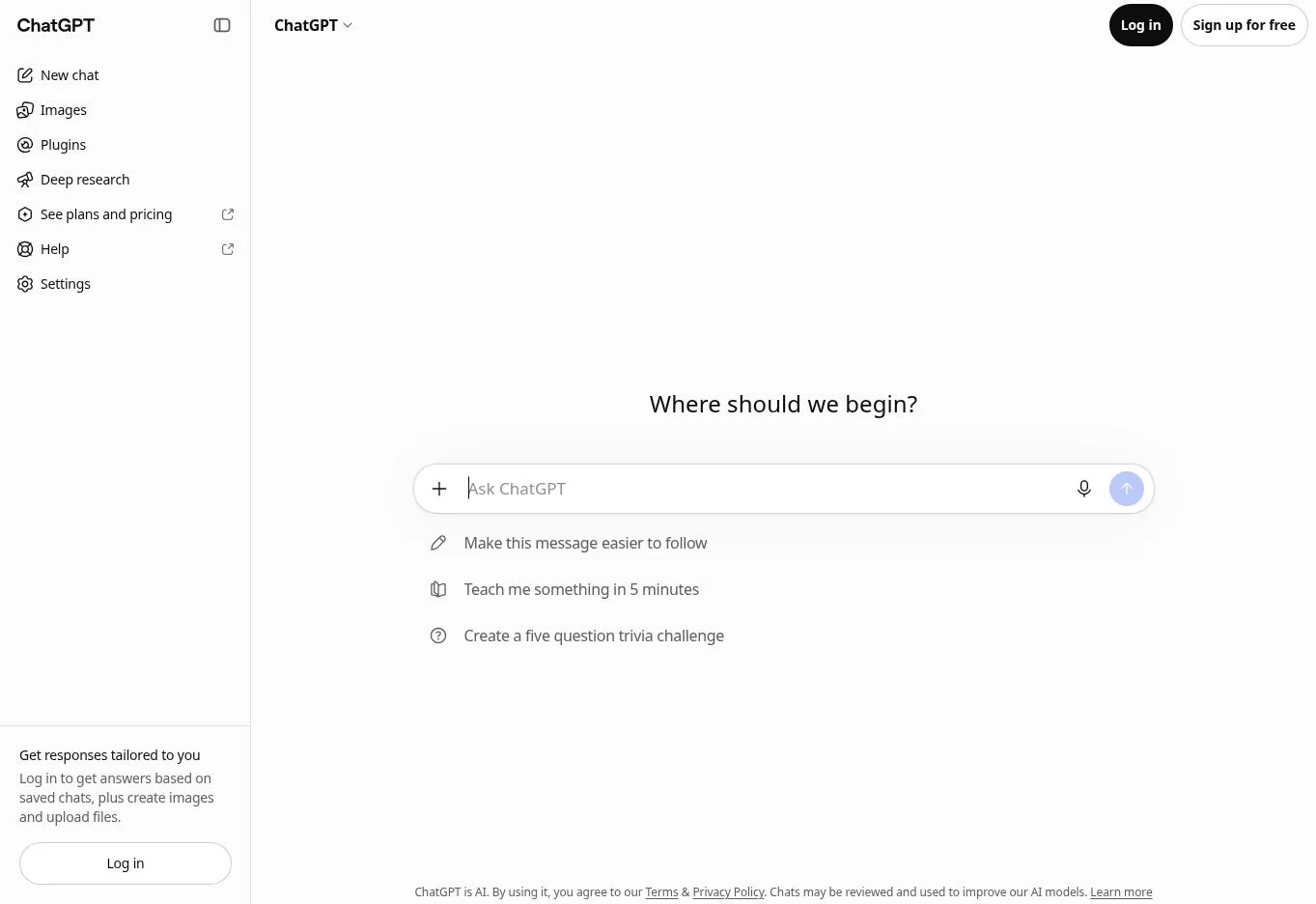
The official references linked beside their claims are OpenAI’s crawler documentation, ChatGPT search guidance and publisher FAQ, checked on 2 October 2026. Homepage imagery records the interface shown at capture time. It does not demonstrate ranking performance.
The 15-strategy workflow, qualitative table and business experiment are original editorial recommendations. Keyword volume, difficulty and citation benchmarks were not measured. No first-hand product benchmark, student outcome, client result or guarantee is claimed.